


Former Pakistani prime minister Zulfikar Ali Bhutto spent nearly nine years fighting a legal battle in India to reclaim his family’s property in Mumbai, while simultaneously seeking compensation for the same assets in Pakistan. The case later became a political controversy, with Bhutto’s opponents questioning his citizenship and loyalty.
According to a BBC Urdu report, the dispute began after the partition of British India in 1947, when Bhutto’s family moved to Pakistan while he was pursuing his education abroad.
Family property in Mumbai
Bhutto’s father, Sir Shah Nawaz Bhutto, a prominent Sindh politician and landlord, had moved to the princely state of Junagadh to take up government responsibilities. He left his young son in Mumbai to continue his education and look after the family’s property.
According to lawyer Sanjoy Ghose, writing for Bar & Bench, the family owned a house at 4A, Worli Estate, which Sir Shah Nawaz had leased from the Bombay Municipal Corporation for Rs25,344, with an annual rent of just one rupee.
The family also owned the multi-storey Astoria Hotel in Mumbai’s Fort area, which reportedly generated more than Rs110,000 in annual rent in 1946–47. Sir Shah Nawaz had transferred these properties to his son when he was 18.
Bhutto left for the United States in early September 1947. His father settled permanently in Karachi in November that year.
Nine-year legal battle in India
On July 6, 1949, Indian authorities declared Bhutto an “evacuee” and took his property into government custody under laws dealing with assets left behind by people who had migrated to Pakistan.
According to lawyer and author A.G. Noorani, Bhutto challenged the decision before various authorities, including the custodian of evacuee property, the Custodian General, the Bombay and Punjab High Courts, and ultimately the Supreme Court of India.
In his legal petitions, Bhutto maintained that he was an Indian citizen who had travelled to the United States on an Indian passport and had not made Karachi his permanent home at the relevant time.
In a 1956 appeal, he argued that his parents’ residence in Karachi and his marriage there did not automatically establish that the city was his permanent home.
However, Bhutto was also pursuing compensation in Pakistan for property left behind in India.
Compensation claim in Pakistan
In 1956, Bhutto filed claims in Pakistan under the Displaced Persons (Claims) Act, 1955, seeking compensation for his Mumbai assets.
He valued the Astoria Hotel at Rs1.2 million and the house at Rs140,000. Initially, the claims officer approved a much lower valuation for the hotel. Following further proceedings, the Deputy Claims Commissioner raised its assessed value to Rs997,991 in October 1956.
A subsequent review set the capital value of the property at Rs4.43 million in September 1957, using a government-approved formula based on annual rental income.
This created the central controversy: while Bhutto was arguing in India that he remained an Indian citizen entitled to reclaim his property, he was seeking compensation in Pakistan for the same assets.
On August 13, 1958, Bhutto asked India’s Supreme Court to withdraw his appeal, stating that he had now permanently settled in Karachi. The court allowed the withdrawal on November 3, 1958, shortly after he had joined Ayub Khan’s cabinet as commerce minister.
Citizenship claims become a political issue
The dispute resurfaced in November 1965 when India’s rehabilitation minister, Mahavir Tyagi, discussed Bhutto’s claims in the Rajya Sabha. Indian parliamentary records cited by Noorani indicated that Bhutto had declared himself an Indian citizen in proceedings concerning the recovery of his property.
In June 1967, the matter was raised in Pakistan’s National Assembly. Information Minister Khawaja Shahabuddin said the documents appeared to show that Bhutto had presented himself as a Pakistani citizen in Pakistan and an Indian citizen in India until 1958.
President Ayub Khan also criticised Bhutto in diary entries, accusing him of using claims of Indian citizenship to obtain compensation. These allegations became part of the political dispute between the two men.
Bhutto’s supporters, however, offered a different explanation. In his book Bhutto: A Political Biography, Salman Taseer argued that Bhutto had been a young man trying to recover money tied up in property after partition. He maintained that the legal complications did not, by themselves, prove disloyalty to Pakistan.
Taseer also noted that Bhutto had obtained a Pakistani passport in July 1949, while continuing to pursue the property case in India.
The controversy continued after Bhutto entered politics
After founding the Pakistan Peoples Party on November 30, 1967, Bhutto faced renewed criticism over the case. According to Rafi Raza’s book Zulfikar Ali Bhutto and Pakistan, 1967–1977, the allegations were repeated in parliament and in a Dawn editorial published in July 1967.
Bhutto’s legal adviser sent the newspaper a notice demanding a retraction and damages, arguing that the relevant events—including his passport history, Indian court proceedings and compensation claim in Pakistan—were matters of public record. The party ultimately decided not to pursue a lengthy defamation case.
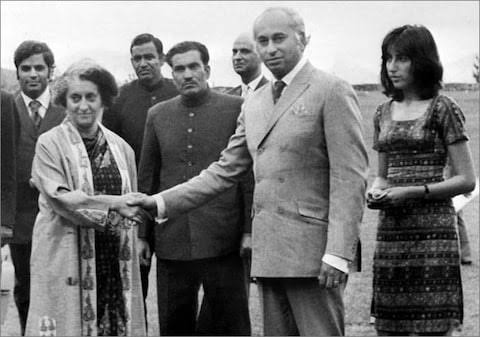
The controversy also reached India’s parliament. In August 1967, Indian foreign minister M.C. Chagla described the issue as one of “dual loyalty”. When asked whether Bhutto could regain Indian citizenship and recover his property if he returned to India, Chagla said the matter would be governed by citizenship law but ruled out returning the properties. Prime Minister Indira Gandhi also indicated disagreement with the proposal.
After General Zia-ul-Haq overthrew Bhutto’s government in 1977, the former prime minister’s Indian citizenship claims resurfaced in official white papers. Biographer Stanley Wolpert argued that some of the allegations were misleading and that Bhutto’s efforts to recover his family’s property should be understood in the context of the complicated legal and financial disputes created by partition.
The Mumbai property case thus followed Bhutto from his student years into his political career, becoming a lasting point of controversy over citizenship, property rights and national loyalty.