


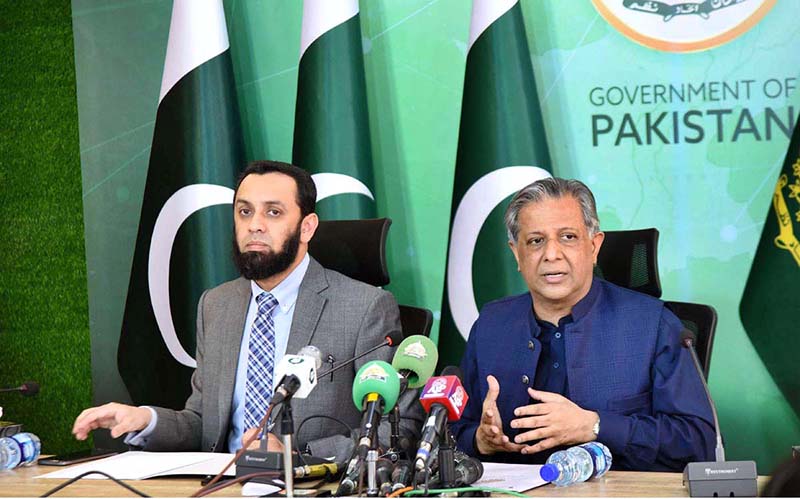
Federal Information Minister Ataullah Tarar has defended the federal government’s decision to impose governor’s rule and an emergency in Khyber Pakhtunkhwa (KP), claiming that the move has given residents hope for improved security and protection.
Speaking at a press conference alongside Law Minister Azam Nazeer Tarar on Tuesday, the information minister said the decision was driven by security concerns rather than political considerations.
He also claimed that the limited public response to protests against the move reflected a lack of widespread support for the Pakistan Tehreek-e-Insaf (PTI)-led provincial government’s position.
“If the people of KP had supported the PTI government’s stance on terrorism, millions would have taken to the streets,” Ataullah said, claiming that only a small number of people had gathered to protest.
He maintained that residents wanted peace, security and protection for their lives and livelihoods, adding that the federal government intended to address what it described as links between politics and militant activity.
Government cites surge in terrorist incidents
Explaining the decision, Law Minister Azam Nazeer Tarar pointed to what he described as a significant increase in terrorist incidents in KP.
According to figures presented at the briefing, around 8,600 attacks were recorded between 2024 and 2026, compared with 2,900 during 2020–2024.
The law minister described coordination between federal and provincial authorities as essential to an effective counterterrorism strategy. He said security agencies needed to work under a coordinated framework to tackle the growing threat.
Azam also criticised the previous PTI-led provincial administration, accusing it of failing to respond adequately to the deteriorating security situation.
He referred to attacks on KP police personnel and security forces, as well as the loss of civilian lives, arguing that the federal government could not ignore the situation.
According to the minister, the Centre had remained in contact with provincial authorities and explored various options before deciding to impose emergency measures.
He alleged that political considerations had taken precedence over national security in the provincial government’s approach.
Constitutional provisions invoked
The federal government has relied on Article 232 of the Constitution to impose an emergency in the province, while governor’s rule was introduced under Article 234.
Azam said Article 232 provides for emergency measures in situations involving serious internal disturbances that a provincial government is unable to control effectively.
He argued that the circumstances in KP required federal intervention, maintaining that protecting citizens should remain the government’s primary responsibility during a security crisis.
The law minister also questioned why the same measures had not been considered for Balochistan, where militant violence remains a major concern.
In response, he pointed to the conduct of the Balochistan government, saying its chief minister regularly visited areas affected by terrorist attacks and personally supervised relief and response efforts.
Federal ministers reject allegations of political motives
Ataullah rejected claims that the Centre’s decision was intended to undermine the PTI, insisting that the federal government was pursuing a unified counterterrorism policy.
He argued that different levels of government could not follow conflicting approaches to tackling militancy, particularly when the country’s security was at stake.
The information minister also questioned how funds transferred to KP through the National Finance Commission award had been used, asking why more resources had not been directed towards strengthening police capabilities and security infrastructure.
He further criticised the provincial administration over what he described as broader governance failures, including a lack of progress in education, healthcare and public services.
The minister accused the PTI-led government of maintaining a political-terrorist nexus, though the allegations were presented as the federal government’s position and have not been independently established in the account of the briefing.
Emergency measures follow cabinet meeting
The decision to impose emergency measures came after a federal cabinet meeting on Sunday reviewed the security situation in KP.
According to the federal government, the cabinet expressed concern over what it characterised as the provincial administration’s disengagement from counterterrorism efforts.
Following the meeting, the Centre announced the emergency under Article 232 and governor’s rule under Article 234.
The government also authorised the deployment of Pakistan Army personnel and assets to assist civilian authorities in the province.
In Peshawar, shipping containers were placed at several locations to block roads, while police deployment was increased as part of the security arrangements.
Federal ministers have since defended the measures, arguing that the province’s security situation required a stronger and more coordinated response.
Deputy Prime Minister and Foreign Minister Ishaq Dar also defended the decision a day earlier, saying it was intended to curb terrorism rather than pursue a political agenda.
Tensions between Centre and PTI continue
The latest development comes amid continuing tensions between the federal government and the PTI over security policy in KP.
Counterterrorism has been a major point of disagreement between the two sides and contributed to the breakdown of talks held on October 3.
The PTI has maintained that it has been excluded from important security decisions affecting the province. It has also called for a review of the existing counterterrorism strategy and opposed military operations.
The federal government, meanwhile, has repeatedly criticised the provincial administration’s handling of militancy and raised objections to its position on negotiations with the Afghan Taliban.
With governor’s rule now in place, the dispute has entered a new phase, placing renewed focus on constitutional authority, provincial autonomy and the future of counterterrorism efforts in Khyber Pakhtunkhwa.
While the federal government maintains that its actions are necessary to restore security and effective governance, the competing positions of the Centre and the PTI are likely to remain central to the political debate surrounding the province.